Ashunda Prep: Global to U.S. University Bridge
A university readiness and transition program helping international secondary students articulate their direction and prepare for U.S. higher education.
An original admissions narrative. Evidence of readiness. A direction you can explain.
Students develop the knowledge and judgment to:
Your experience has meaning. Learn to make that meaning understood.
Students connect academic direction and admissions narratives with the communication and independence expected in U.S. higher education. Each experience combines reflection, practical learning, a focused exercise, and a next action.
Through direction, evidence, structure, and revision, students develop original narratives explaining their academic interests, preparation, and university fit. They retain their own voice and learn to explain their writing choices.
The studio supports statements of purpose, personal statements, university essays, and supplemental responses, guided by each institution’s actual prompt and requirements.
International secondary students preparing for U.S. undergraduate study, and the schools, education organizations, college counseling programs, and university access initiatives supporting them.
Students build communication, agency, application readiness, and academic transition skills. The program does not provide English tutoring, test preparation, admissions services, or writing on a student’s behalf.
Ashunda Prep: Pathway Forward supports students in grades 9 through 12 through a 36 week school year experience in agency, academic planning, college access, and career readiness, including first generation students navigating unfamiliar pathways.
Four developmental phases. Fourteen core modules. A signature Admissions Narrative Studio.

Understand the U.S. higher education system, admissions expectations, English proficiency requirements, and university fit. Students build a requirements tracker and learn to distinguish verified information from assumptions.

Translate international experience for a U.S. audience, develop an original admissions narrative, and prepare for recommendations. The four part Admissions Narrative Studio moves through direction, evidence, structure, and revision.

Practice academic English, professional correspondence, responsible artificial intelligence use, academic integrity, and U.S. classroom participation. Students rehearse the communication they will need rather than memorize a script.
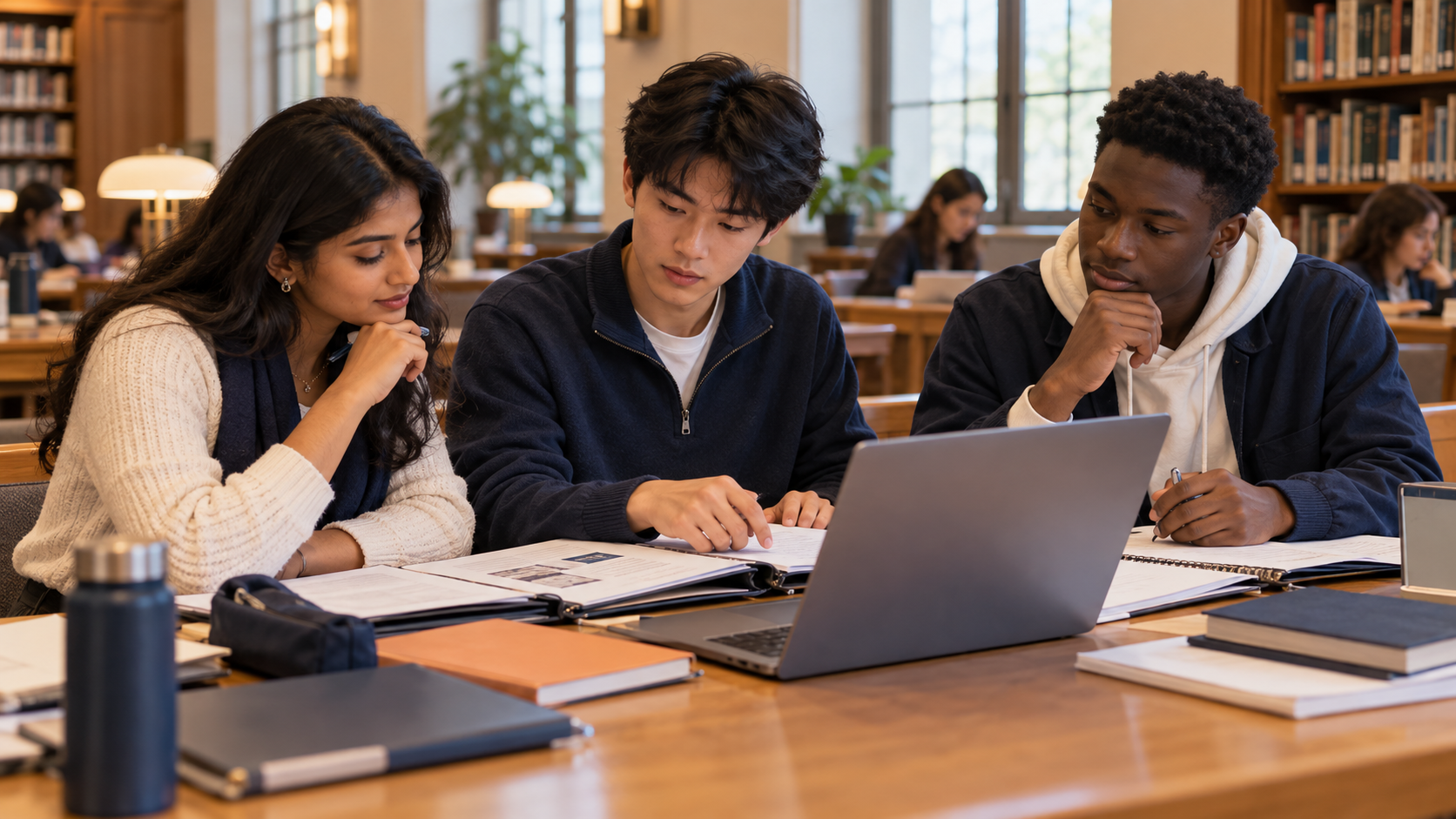
Develop student agency, help seeking, cultural and academic transition plans, and a U.S. Higher Education Readiness Portfolio. Students identify resources, unresolved questions, and practical next actions.
The portfolio can include an admissions narrative framework, university fit analysis, professional email examples, recommendation preparation materials, an English proficiency requirement plan, an academic transition plan, a student support resource plan, a personal readiness reflection, and a next step action plan.
A consistent rhythm that turns reflection into action.
Recenter · 5 minutes
Notice the question, your assumptions, and what you already know.
See It · 10 minutes
Examine a realistic situation and identify the actual task.
Learn It · 10 minutes
Build practical understanding and identify a useful principle.
Work It Through · 25 minutes
Create a useful artifact or rehearse a response.
Check Your Direction · 5 minutes
Review evidence and identify what needs development.
Next Move · 5 minutes
Choose one specific action beyond the lesson.
Fourteen modules include a four part Admissions Narrative Studio, creating 17 guided learning experiences. Research, drafting, and revision continue between experiences as needed. Institutions discuss a cohort calendar suited to their students.
Purposeful practice, evidence of progress, and an institutional delivery plan.
Participation: Access and completion records show whether students are engaging with the learning sequence.
Evidence: Narrative drafts, university research, correspondence practice, and transition plans show what students are learning to do.
Feedback: Students review work for prompt alignment, truthful evidence, reflection, clarity, and ownership. Individual feedback provision is specified in the institutional delivery arrangement.
Human response: Designated educators, advisors, counselors, and appropriate professionals provide the support their roles require. Completion records alone do not establish a student’s readiness.
Discuss cohort needs, student stage, scheduling, access, designated staff, and feedback responsibilities. The learning sequence supports facilitated groups or guided independent learning with an appropriate institutional support plan.
Global to U.S. University Bridge can serve as the international preparation experience before Ashunda Prep: Pathway Forward, where appropriate to the student’s stage.
Global to U.S. University Bridge: Crossing educational systems and preparing for U.S. university expectations.
Pathway Forward: The broader 36 week experience in agency, academic planning, college access, career readiness, professional development, and leadership.
Making Your Experience Understood
Recall one experience that matters to your academic direction. It may come from school, family responsibilities, independent learning, practical work, or your community.
A title or award may mean little to a reader who does not know your school or community. Notice where your draft assumes unfamiliar knowledge.
Connect context, your action, and its meaning. The reader needs to understand your contribution and what the experience helped you learn, rather than read a list of impressive labels.
Create one paragraph: give the reader brief context, identify what you did, explain what you learned, and connect that learning to your present direction.
Can a reader unfamiliar with your setting understand your contribution? Is every claim truthful? Does the paragraph answer the actual writing task and sound like you?
Ask a reader to identify the clearest part and one point that needs context. Revise that point while keeping ownership of your writing.
International experience in language education, student success, and purposeful development.
Ashunda D. Thomas, MA, PhD.c has supported international students since 2016 through English as a Second Language teaching, including business etiquette and professional communication. Her international work has expanded across graduate student success coaching and psychological support, bringing together experience in education, communication, and purposeful development.
As an Executive Coach and Industrial Organizational Psychology practitioner, she translates psychological insight into practical professional development. She has coached professionals and executives since 2011, supporting clearer decisions, grounded performance, sustainable leadership, and career development.
Her higher education work includes success coaching for students in master’s and doctoral programs. Her online practice serves students and clients across international backgrounds and geographic locations. She supports students as they navigate academic demands, work through challenges, maintain focus on their goals, and identify practical next actions. Her current work also includes nonclinical psychological support for an international client population.
This breadth of experience informs her attention to cultural context, academic and professional communication, student agency, and help seeking. In Global to U.S. University Bridge, she brings that perspective to the academic, admissions, and transition expectations students may encounter when crossing educational systems.
Her approach connects reflection with practical application. Students work to understand their experience, communicate its meaning, and choose informed next actions while preserving their own voice and cultural identity.
A former graduate student’s perspective on sustained guidance, practical support, and purposeful progress.
This recommendation reflects Ashunda’s work supporting a student through a doctoral journey.
“She consistently provided valuable guidance, encouragement, and practical solutions that helped me navigate challenges and stay focused on my goals. She even attended my doctoral dissertation defense, demonstrating her genuine commitment to my success.”
“Ashunda is highly intelligent, thoughtful, dependable, and an excellent listener. She understands people's challenges, recognizes their strengths, and motivates them to achieve their goals. Her expertise in organizational psychology, executive coaching, and professional development makes her especially effective at helping others overcome obstacles and reach their full potential.”
“Beyond her professional expertise, Ashunda is a gem of a person. She is incredibly kind, caring, patient, respectful, and supportive. She treats people with genuine warmth, celebrates their achievements, and makes them feel valued and understood.”
“Ashunda is the kind of person who makes a lasting difference in people's lives. Her dedication, integrity, and exceptional character make her an outstanding coach, mentor, and trusted professional.”
Former graduate student
Selected excerpts from a recommendation
Plan a readiness experience for your school or educational organization.
For schools and educational organizations seeking a structured readiness experience for international secondary students preparing for U.S. higher education.
Share your organization, country, student age or grade range, anticipated cohort size, desired timeline, and primary readiness priorities. Institutional discussions establish fit, delivery arrangements, access, and implementation responsibilities before enrollment.
The program is educational and developmental. It does not provide immigration advice, legal advice, admissions guarantees, psychotherapy, diagnosis, individualized counseling, or standardized test preparation. It is not an admissions service.
Students remain responsible for following the official admissions, documentation, English proficiency, financial, and immigration requirements established by their chosen institutions and applicable authorities. Institutional staff and appropriately qualified professionals retain responsibility for direct advising, safeguarding, and specialized support.